

As the search for skilled freelancers in startups and organizations is on a rise, the growth and success of these organizations relies on a well thought out recruitment process.
That’s where the difference between finding talents, and hiring the right tech talent in Africa becomes clear. So what is a recruitment process, and what does a thought out process look like?
The recruitment process is a systematic approach used by organizations to find, and hire new employees. Think of it as an SOP for attracting, identifying, and retaining the right people for your organization.
So, how do you develop a recruitment process that addresses the needs of your business, and also communicate those needs to prospective hires?
These 5 steps are a clear cut process that ultimately sets your organization and its new hires up for success.
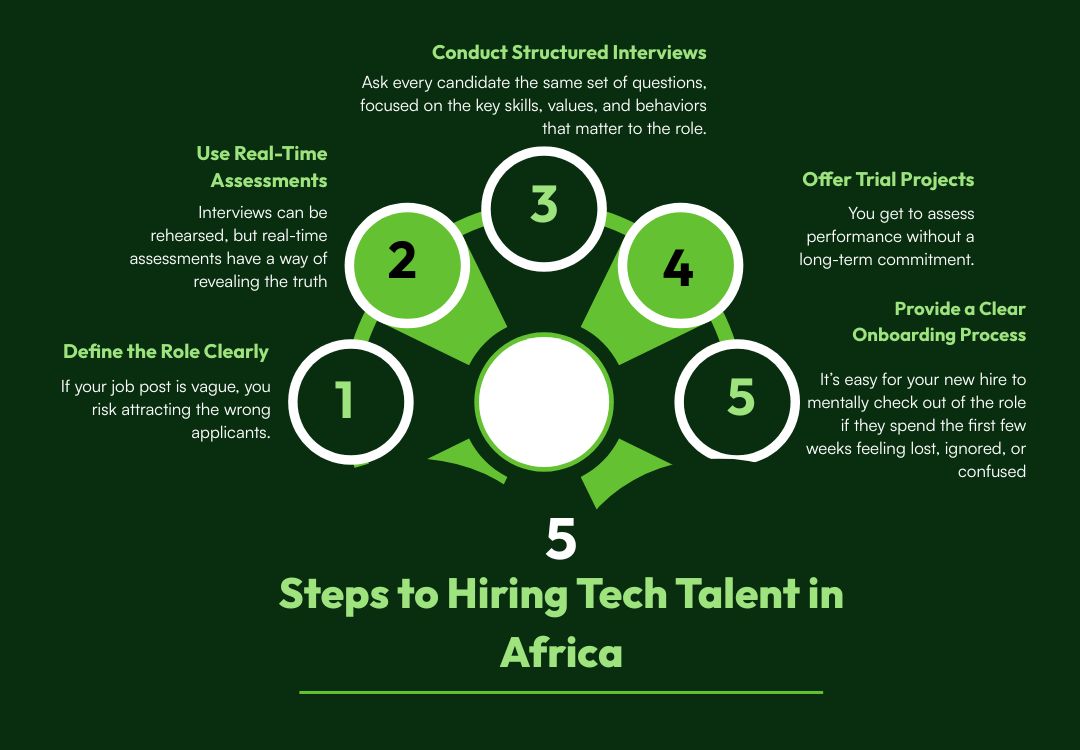
5 Steps to Hiring Tech Talent in Africa
1. Define the Role Clearly
When hiring tech talent in Africa, clarity is the watchword for this first step.
Think of it like going on a road trip in a new and different state with your GPS acting as your guide. Would you trust a GPS that says “Head somewhere in the north”?
Probably not.
The same goes for tech talents in Africa, your job role/description is their GPS. If your job post is vague, you risk attracting the wrong applicants or worse, losing the right ones before they even apply.
So, how do you clearly define a role for prospective hires ?
Start with the tech stack.
Let’s assume you’re building a frontend-heavy platform with React or Vue, or your backend is written in Django or Node.js. Maybe you’re even hosting everything on AWS with CI/CD pipelines on GitHub Actions.
How do you describe these tech skills accurately to prospective hires?
Be clear with what your goal is. If your team needs a developer skilled in React or Vue, state it. If Django or Node.js is a language they ought to be familiar with, state it too.
How much experience in these skills does your team require? Are you looking for beginners (if you’re providing room for training on the job), or do you need someone with an expert level of experience?
If you leave it ambiguous, you’re leaving room for tech talents in Africa who are familiar with coding but not experts in those fields to apply.
This first filter helps to separate what your team wants versus what your team needs. This also gives the developers an idea of the skill set expected from them.
Next, clarify key responsibilities.
What are some key responsibilities expected of them to handle?
Don’t just say “build web applications.” That’s as vague as saying a chef “cooks food.”
Be specific with what responsibility they’ll handle as soon as they’re onboarded: Are they “working with existing systems or contributing to project discussion”, or will they maintain legacy code or participate in sprint planning?
Will they “oversee team members or coordinate with other departments”, or will they manage a junior dev or collaborate with UI/UX designers?
Clarity is key because clearly stated responsibilities leave no room for slack, and it helps candidates mentally place themselves in the role.
Then, outline expected outcomes.
What KPI’s are you ticking off your list? What does success look like in the first 3, 6, or 12 months? Are they expected to launch a new feature, reduce server response time, or scale a product to 10,000 users?
When expectations are clear, top tech talent in Africa sees a challenge they can rise to, and the rest move on, which is exactly what you want.
Here’s the bottom line: when you define the role clearly, you’re not just filling a vacancy. You’re making a promise, and the right people will want to help you keep it.
2. Use Real-Time Assessments
Resumés can be polished, interviews can be rehearsed, but real-time assessments have a way of revealing the truth. Just as you wouldn’t hire a chef without tasting their meal, you also shouldn’t hire talents without having firsthand proof of their expertise in their respective fields.
Use job-relevant challenges to test practical skills.
Say you need developers that can frequently debug legacy code, you should test for that. Create a mock-test from your team’s backlog using tools like Codility, or HackerRank, and set up coding problems that will test the skill proficiency of each candidate.
If they need to work with APIs, make that the challenge. This isn’t just about right or wrong answers, it’s getting to understand how they think, how they approach the problem, and how they write code under pressure.
Hiring a content writer or designer instead?
No problem. Ask for a quick draft on a specific topic or a design mockup for a common use case. Don’t just evaluate creativity, look for clarity, accuracy, and how well they follow instructions. By doing this, you’re checking if they have the ability to meet your brand’s needs or not.
In some cases, some candidates talk a good game but can’t deliver. So before you make that offer, ask yourself: have I tasted the food yet?
3. Conduct Structured Interviews
How do you make a fair call between 3 candidates who are asked different questions? You don’t.
That’s where structured interviews come in.
Structured interview is an assessment tool used to maintain the consistency of the interview process. You ask every candidate the same set of questions, focused on the key skills, values, and behaviors that matter to the role.
This levels the playing field and gives you measurable insights, not gut feelings.
Start with communication.
Ask scenario-based questions: “Tell me about a time you had to explain a technical concept to a non-technical team member.” From their response, you can have a fair insight on how they do well with collaborating with other team players.
Evaluate cultural fit, but don’t make it vague.
Rather than asking “Do you think you’ll fit in here?”, ask, “We work remotely with async communication, how will you stay accountable and connected in that kind of setup?” Now you’re learning how they’ll flow with your team’s way of working, not just their personality.
Measure creative problem-solving.
Think back to a time your team experienced a challenge that caused your workflow to slow down, bonus insight if your team navigated their way out of it successfully, and ask them how they would tackle it if they encountered the same challenge.
This reveals not only technical thinking but also their ability to think outside the box and be solution-oriented.
And here’s the key: score every answer using a clear rubric. When interviews are structured and data-driven, you’re not making decisions based on charm, fluency, or shared interests, you’re hiring based on alignment, capability, and readiness.
So, ask yourself: are you interviewing to impress, or to assess?
4. Offer Trial Projects
When hiring tech talent in Africa, the beauty of trial projects is that they minimize risk on both sides. You get to assess performance without a long-term commitment, and the candidate gets a feel for your workflow and culture. If the chemistry clicks, great, you’ve found a solid match. If it doesn’t, you’ve saved yourself a costly hiring mistake.
Set up a 2–4 week paid trial project that mimics actual work. It doesn’t have to be mission-critical, but it should reflect tasks they’d regularly handle. For a developer, that might be building a feature or debugging an existing one. For a writer, it could be creating a blog post or optimizing existing content. Don’t hand them a throwaway task just for the sake of testing, ensure they’re relevant to the job.
During this phase, watch closely.
- Do they ask the right questions?
- How do they handle unclear instructions?
- Can they take feedback without defensiveness?
- Do they meet deadlines, or do things go silent?
So before you hire full-time tech talent in Africa, take the test drive. The road ahead gets much smoother when you do.
5. Provide a Clear Onboarding Process
You defined a clear job role for your tech talent in Africa, you’ve made use of real-time assessments, you’ve conducted a structured interview, you’ve also carried out trial projects, and you’ve found the right fit.
Congratulations, but this is where you have one final lap to run.
Many companies drop the ball right after hiring their ‘perfect fit’ because they do not pay attention to their onboarding process. The onboarding process when hiring tech talent in Africa is as important as the first step. It is like providing all the right tools for your handyman to experience a great work flow.
A structured onboarding is your first real commitment to the new hire. It’s not a checklist, it’s a launchpad.
Start with access.
Share everything that your tech talent in Africa will need to hit the ground running: product roadmaps, key documentation, and your team’s communication tools (Slack, Trello, or Asana). Don’t make them chase basic info. If someone has to ask, “Who do I talk to about X?” in week one, the onboarding has already failed them.
Let them know who’s in charge of what, and how to get to them without having to walk round the field.
Introduce them to the team and workflows.
Here’s an undeniable truth amongst teams; a smooth onboarding process is the best tool for retention. It’s easy for your new hire – no matter how enthusiastic they are about the job- to mentally check out of the role if they spend the first few weeks feeling lost, ignored, or confused about anything that relates to the team, and the job itself.
How do you preserve the enthusiasm of your tech talent in Africa from day one?
Create room for intentional introductions. Go beyond the “John just joined Slack, Say Hello!”, mantra. Let them meet the team, and let the team meet them. Walk them through your processes: how tasks are assigned, how feedback is given, what “done” actually means. Culture isn’t absorbed—it’s taught.
Reinforce expected KPI’s.
Just as you’ve defined it in step one, have a final discussion where KPIs, deliverables, and 30-60-90 day goals are restated and defined for clarity. Are they expected to ship a feature within the first month? Write three blog posts? Redesign a landing page? Refresh the goals.
It’s beyond the job description at this point, it’s about ensuring that the team’s performance goals are kept at the top of mind.
So ask yourself: if you were a tech talent in Africa stepping into this role, would you feel ready to succeed?
Wrapping Up: Turn Strategy into Action
Platforms like Hire Talent Africa are proof that the future of African teams contributing to the growth of global tech teams is here.
With an expanding pool of agile, highly skilled, and innovation-driven professionals, it’s no longer a question of if companies should hire tech talent in Africa, but how soon they will.
With each step building towards one outcome, you can find and retain the right tech talent in Africa to help bring your team’s goal and vision to life.
So, what’s next?
If you’re serious about scaling efficiently, building diverse teams, and staying competitive in a global market, then hiring tech talent in Africa is your next strategic move. Don’t let the momentum pass you by.